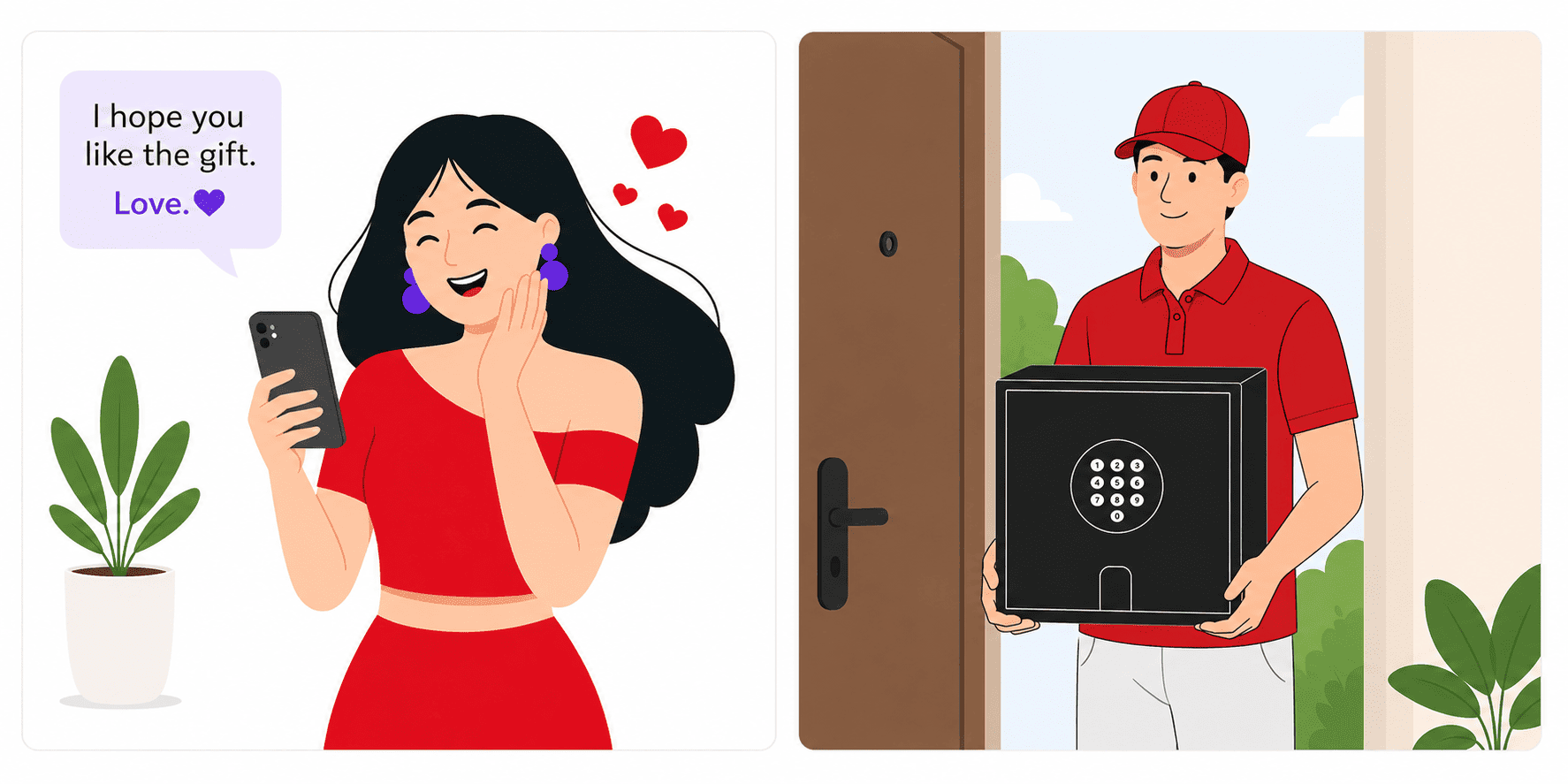
Hyderabad has emerged as one of India's fastest-growing markets for lab-grown diamonds, driven by rising consumer adoption and a concentration of specialist retailers. High per-capita income in corridors like Jubilee Hills and Banjara Hills, a large tech-sector workforce comfortable with online purchases, and the cluster of dedicated LGD stores that opened between 2022 and 2025 have made the city one of the most active LGD markets in the country.
Road No. 36, Jubilee Hills alone now has multiple dedicated LGD stores within walking distance of each other. Banjara Hills, Kondapur, Gachibowli, Hitech City, Madhapur, Kukatpally — the demand is spreading across the city. Consumers here are educated, digitally comfortable, and increasingly asking the question every store owner knows is coming: can you deliver it to my home?
Most stores hesitate. Not because they don't want to offer home delivery — because they aren't sure how to do it safely.
Why Home Delivery for Lab Grown Diamonds Is Different
Lab grown diamonds occupy an unusual position in the Indian market. Individual pieces can be worth ₹50,000 to ₹5 lakh or more — but they are increasingly purchased the way younger consumers buy everything else: online or via WhatsApp, with the expectation of home delivery.
Standard courier infrastructure was never designed for this.
A regular courier optimises for volume, speed, and cost. The rider handling your package may also be handling fifty others. The delivery process for a ₹2 lakh diamond ring is often no different from a ₹500 skincare order — same packaging, same verification at delivery, which is to say almost none.
For a store, the consequences of one failed delivery are not proportional to the value of the piece. A lost or tampered ₹1 lakh diamond is not just a financial loss. It is a customer relationship ended permanently, a story that spreads through family and friend networks. In a city like Hyderabad, where the jewellery community is tight-knit and word travels fast, the reputational cost is the real risk.
What Customers Are Actually Asking For
When a customer asks "can you deliver it to my home?", they are not asking whether you are physically capable of sending a rider with a box. They are asking something more specific — even if they don't articulate it.
They are asking: will it arrive exactly as it left your store?
That question has three components: will it be the right piece, in the right condition, untampered with? Will I know who is bringing it and can I trust them? If something does go wrong, is there a way to make it right?
Most standard delivery setups answer none of these. When stores say yes to home delivery without the right infrastructure, the experience often creates more anxiety than the in-store visit it was meant to replace.

The Four Things That Actually Make Diamond Delivery Safe
Safe home delivery for lab grown diamonds is not complicated in principle. It requires four things — and most standard couriers provide none of them.
1. Tamper-proof, sealed packaging at source. The piece should leave your store in packaging that makes any access physically evident. Not just a sealed envelope — a sealed container where any tampering is irreversible and visible. The packaging is the first line of evidence. If a dispute arises, an intact seal says everything.
2. OTP or 2FA-verified handoff at delivery. The package should only be openable by the intended recipient, using a unique code sent directly to them. This removes the single biggest risk in standard delivery: the piece being handed to the wrong person, or opened in transit by someone who "needed to check something." An OTP-locked delivery creates a hard chain-of-custody — the piece moves from your store to one specific person, verified at the exact moment of handover.
3. Real-time GPS tracking throughout the journey. Both you and your customer should be able to see exactly where the package is at any point. Not just "out for delivery" — live location. Any deviation from the route, any extended stop that wasn't expected, triggers an alert. This is standard practice in cash logistics and has been for decades. Jewellery delivery is simply catching up.
4. Background-verified delivery personnel. The person carrying a ₹2 lakh diamond piece from your store to a customer's home in Jubilee Hills is, for that duration, responsible for one of your most valuable assets. Gig-economy KYC — Aadhaar and PAN verification — was not designed for this responsibility. Police verification, criminal background check, financial background screening: these are the standards that cash logistics have applied for years. They are the standards that high-value jewellery delivery now requires.
The Home Trial Complexity

Home delivery is one thing. Home trial — where a customer receives multiple pieces, tries them over 24 to 48 hours, and returns what they don't want — is a different and considerably more complex logistics operation.
It is also the feature that Hyderabad's LGD stores are increasingly being asked to offer. Ladia, Aukera, Nivara — every store in the Jubilee Hills cluster knows that CaratLane and Bluestone have normalised home trial as a consumer expectation. The question is no longer whether to offer it. The question is how to do it without turning every trial batch into an unmanaged risk.
The multi-piece problem. Three to five pieces travel together. Each has different value. When they come back, there needs to be a verifiable record of exactly what was sent and exactly what was returned — condition, quantity, and the moment of handoff documented at both ends. A receipt and a verbal confirmation from the rider are not sufficient for a ₹4 lakh trial batch.
The dwell time problem. During the 24 to 48 hours that pieces sit at the customer's home, they are outside your custody entirely. Many insurance policies do not explicitly cover this period. Most stores have not thought through what happens if a piece is damaged, lost, or substituted during the trial window — because it hasn't happened yet. But at scale, it will.
The return journey problem. Customers who have decided to return a piece are not focused on packaging it carefully. They are focused on the exchange, the new piece they want, the refund timeline. The incentive to document condition at return is low. Without photo verification at collection — taken at the customer's door, before the rider leaves — there is no objective record of what was handed back.
Home Trial Process
Forward delivery and return leg — both secured
10 steps. Every handoff documented at both ends.
Forward leg
Return leg
What a Properly Secured Home Trial Looks Like
The tools to solve these problems already exist. Once the systems are in place, secure delivery becomes routine.
A properly secured home trial for an LGD store in Hyderabad looks like this:
- Each piece is individually photographed and documented at your store before dispatch. Weight, condition, and description are recorded.
- All pieces are placed in tamper-evident, sealed packaging. A unique OTP is generated for the delivery.
- A police-verified executive picks up the batch and the customer receives a live tracking link and their delivery OTP.
- At the customer's door, the OTP unlocks the package. The executive documents the handover with a photo. The customer signs a digital receipt.
- At the end of the trial, the executive returns to collect. Before leaving the customer's door, each returned piece is photographed and the condition is documented. The pieces are re-sealed in tamper-evident packaging.
- On arrival back at your store, the return is documented against the original dispatch record. Everything is reconciled.
Every step in this process serves one purpose: making the truth of what happened at each moment objectively verifiable. If a customer says a piece arrived damaged — you have the photo from dispatch. If a piece comes back incomplete — you have the photo from collection. The documentation removes the ambiguity that makes disputes so damaging.
Safe Home Delivery Checklist — for LGD store owners
- ✓ Tamper-proof, sealed packaging at dispatch
- ✓ Photo documentation of each piece before it leaves your store
- ✓ OTP or 2FA-verified handoff at delivery
- ✓ Real-time GPS tracking — visible to store and customer
- ✓ Police-verified delivery personnel
- ✓ Insurance covering the full journey, not just in-transit
- ✓ Photo verification at return collection, before rider leaves
- ✓ Digital proof of delivery stored against each order
The Process
How secure lab-grown diamond delivery works
Every step documented, verified, and visible.
What Customers Should Ask Before Agreeing to Home Delivery
If you are a customer — whether you're considering a home trial from a Jubilee Hills LGD store or a doorstep delivery from a D2C brand — these are the questions worth asking before you agree to the arrangement.
Is the delivery OTP-verified? This is the single most important question. If the answer is no — if the piece will simply be handed over by the rider in standard packaging — the rest of the risk follows.
Is the delivery insured, and for how much? Ask specifically about the value covered. ₹50,000 may be the standard — but if the piece you are receiving is worth ₹2 lakh, you need to know whether the insurance matches the value.
Who is delivering it — and how are they verified? A police-verified executive is different from a gig-economy rider. You should ask.
Is there a proof of delivery? You should receive a timestamped, photo-verified confirmation when the piece is handed to you. This is your record too — not just the store's.
The Competitive Case for Getting This Right Now
Hyderabad's LGD market is still forming. Stores that build genuine, secure home delivery capability in the next 12 months will own a significant advantage when home delivery becomes the expected standard rather than the exception.
Stores that don't will find themselves either refusing requests they should be saying yes to, or saying yes without the infrastructure and absorbing the consequences.
Most stores do not need to build this capability themselves. They need access to ready infrastructure — tamper-proof packaging, OTP verification, GPS tracking, verified personnel, and insurance as a complete operation.
See how secure delivery works for LGD stores →
Lab-Grown Diamonds Are Becoming an AI-Native Category
LGD buyers in Hyderabad are not the same customer profile as traditional jewellery buyers. They are younger, more price-sensitive, and more comfortable doing the entire research process online before they speak to a store. Many already use comparison tools, certification lookup services, and D2C platforms before they walk into Road No. 36.
That behaviour is about to accelerate. AI shopping assistants are getting specific enough to handle diamond selection. A customer will ask: Find me a 1-carat oval lab-grown diamond, VS1 clarity, under ₹80,000, IGI certified. The AI compares inventory across stores, verifies the certificate, and recommends the best option. The customer may never browse manually at all.
This changes what the store's job is. If the discovery and selection happen through AI, the physical interaction with the customer is almost entirely the delivery. That moment — the handoff at the door, the condition of the piece, the packaging, the verification — becomes the primary experience of your brand.
Stores that have secure, documented, OTP-verified delivery in place are building for this. Stores that don't are building a customer acquisition funnel that ends at the hardest point to recover from — a delivery that didn't meet expectations.
Frequently Asked Questions
Common Questions
The Bottom Line
Home delivery for lab grown diamonds in Hyderabad is not a question of whether. It is already being asked for, by customers who have grown up expecting delivery to be the default.
The question is whether stores say yes with the right infrastructure — or say yes without it and absorb the consequences when something goes wrong.
The infrastructure exists. It is available in Hyderabad today. Stores that adopt it first build the kind of customer trust that doesn't just close the next sale — it closes the next ten.
The last-mile is where the relationship is kept or lost. Make sure it is kept.

Sources
Anurag Yadav
Co-Founder, mintcrate
Anurag is the co-founder of mintcrate. He has spent the last two years building secure last-mile infrastructure for high-value goods across Hyderabad — studying delivery failure modes, working with cash-logistics protocols, and designing the operational systems that mintcrate runs on. He writes about last-mile logistics, D2C operations, and the future of secure commerce in India. Connect on LinkedIn →