A customer in Banjara Hills opens Perplexity on her phone. She types: "Best place to buy a 1-carat oval lab-grown diamond solitaire under ₹1.5 lakh in Hyderabad, home delivery within 2 days."
She does not open CaratLane. She does not visit Jubilee Hills. She reads what the AI gives her, clicks the first result with confident delivery claims, and places the order.
That interaction is happening right now. Not in a future scenario. Perplexity, ChatGPT, and Google's AI Overviews are already answering jewellery purchase queries with specific product recommendations and brand suggestions. The customer your store spent years cultivating is increasingly starting their purchase through an AI interface — and the AI is making the first cut before she sees your name.
Most jewellery brands in Hyderabad are building for a customer who still browses manually. The customer is already somewhere else.
What AI Jewellery Shopping Actually Looks Like Today
This is not about chatbots on your website. AI jewellery shopping refers to general-purpose AI tools that customers use independently — Perplexity, ChatGPT with browsing enabled, Google AI Overviews, and increasingly autonomous shopping agents that can compare inventory across sellers, verify certifications, check reviews, and surface a shortlist without the buyer doing any of it manually.
The query above is not unusual. Customers are already using AI to narrow their choices before contacting any store. In the D2C jewellery segment — where Hyderabad's market is growing at 25% CAGR — the discovery phase is moving decisively into AI territory. A buyer who asks an AI for "IGI certified oval solitaire under ₹1.5 lakh with safe home delivery in Hyderabad" has already done the equivalent of a store visit. She just did it without speaking to anyone.
How the Buying Journey Is Changing
Traditional commerce vs. AI-assisted commerce
Traditional
AI-Assisted
Steps 1–3 move to AI. Step 4 remains entirely physical.
If current trends continue, a meaningful share of mid-ticket jewellery purchases in India's D2C segment could eventually be completed by AI agents with minimal human involvement at the discovery and selection stage.
When that happens, the only moment of human-to-human contact left in the purchase journey is the delivery. The executive at the customer's door. The sealed crate. The OTP. The photo.
That handoff is the entire brand experience.
The Five Signals AI Reads to Rank a Jewellery Brand
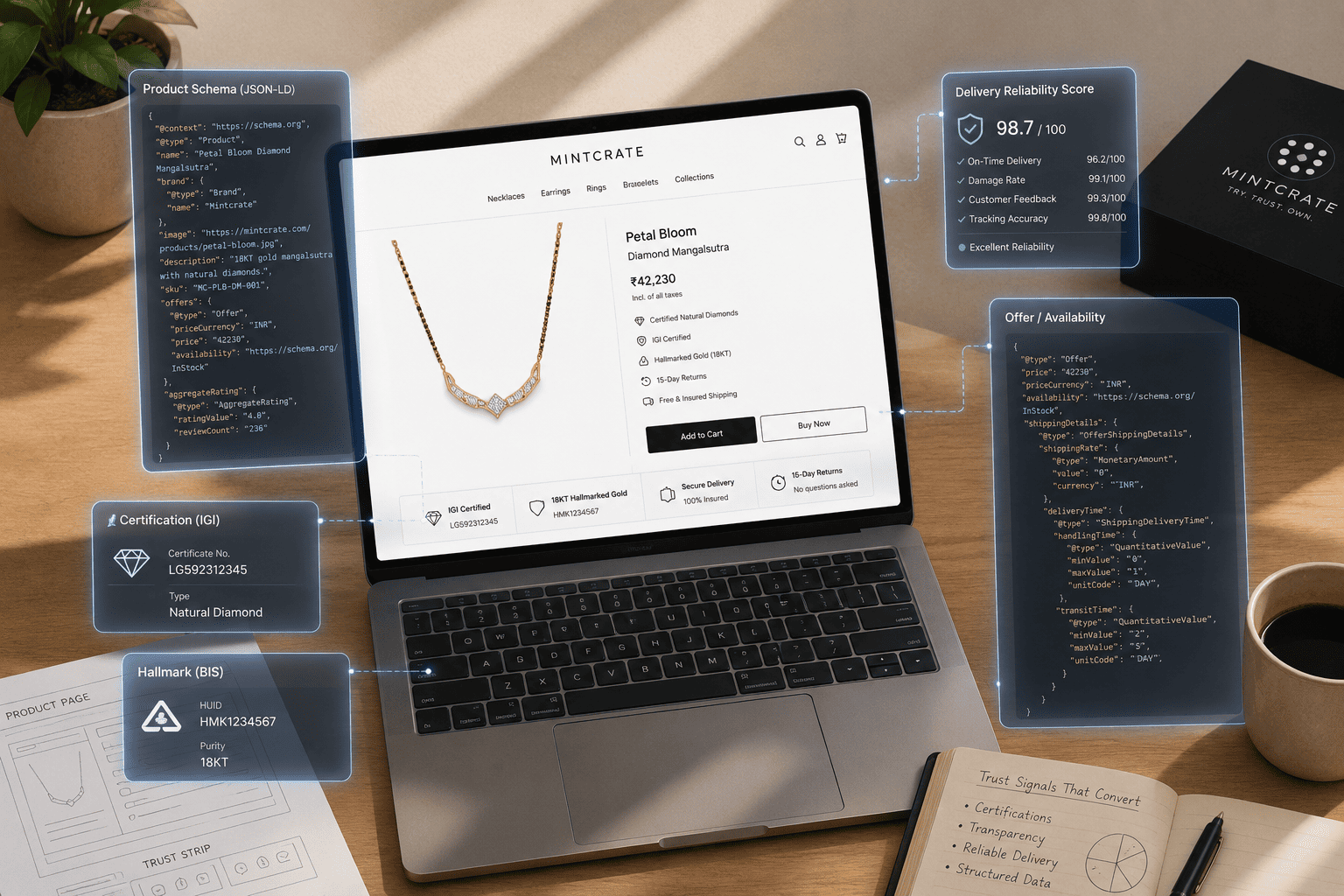
AI systems do not evaluate your store the way a customer does. They cannot feel the weight of your display cases, appreciate your lighting, or notice that your staff knows a customer's name. They parse data. What they rank on is what they can read.
These are the five signals that determine how an AI shopping agent ranks your brand:
Four of the Five Signals Can Be Built. One Cannot Be Faked.
Structured product data is a catalogue project. Certifications are already in the store — they just need to be listed correctly online. Transparent pricing is a business decision, not a technical one. A dispute resolution policy is a page on your website.
Delivery reliability is different. It cannot be declared. It has to be demonstrated, consistently, across actual deliveries — and the record builds in the places AI systems read: review platforms, complaints forums, social media. A single viral complaint about a missing piece, a substituted stone, or a delivery dispute that went unresolved sits in the same data pool that AI systems are trained on and indexed against.
Brands that use gig couriers for high-value deliveries are not just taking on per-delivery risk. They are building a delivery reputation that AI will eventually read. Every unresolved dispute is a negative data point. Every "package arrived tampered" review is a trust deduction. At scale, a delivery track record built on standard courier infrastructure becomes the reason an AI agent deprioritises your brand — even when your product is better.
What an AI-Ready Delivery Operation Looks Like
The standard for delivery that AI systems will increasingly reward is not complicated to describe. It is the same standard that cash logistics built decades ago: documented, verified, insured, and accountable at every handoff.
Applied to jewellery delivery in Hyderabad, this means:
The AI-Ready Delivery Checklist
- Every piece photographed at dispatch with a unique serialised seal — the photo is your proof of what was sent
- Tamper-evident packaging that makes access physically visible — not a standard box with a sticker
- OTP-verified handoff at delivery — the package cannot be opened without the recipient's code
- Police-verified delivery executives — not gig riders whose background checks end at Aadhaar and PAN
- Live GPS tracking from store to door — both brand and customer can verify the route
- Insurance matching the declared value — up to ₹10 lakh per delivery, not a nominal ₹5,000 courier policy
- Insurance coverage stated publicly on your website — so AI can cite it when a customer asks
- A documented dispute process — so AI can reference the fallback with confidence
Brands already doing this are not just protecting individual deliveries. They are building a delivery reputation that compounds. Every positive delivery review is a data point that makes the next AI recommendation more confident. Every zero-dispute handoff is one more signal that the brand can be trusted with a high-value order placed without any human conversation at the buying stage.
The Delivery Is the Brand Experience When AI Buys the Product
Consider what an AI-assisted purchase removes from the equation. No store visit. No salesperson relationship. No browsing experience. No packaging reveal in a showroom. The customer interacts with an AI, selects a product from a shortlist, and waits for a delivery.
What arrives at the door is the brand. Not the product description. Not the Instagram feed. The physical delivery — the packaging, the executive, the crate, the seal, the OTP, the moment the piece is revealed — is the entire brand experience for that customer.
A delivery that goes perfectly is a customer who has no reason to question the brand. A delivery that goes wrong — tampered packaging, a disputed piece, an unresolved claim — is a customer who has no prior relationship to fall back on. There was no store visit. No friendly salesperson. No goodwill built across previous interactions. Just the delivery. And it failed.
The reputational cost of a delivery failure is higher in an AI-commerce world than in a traditional retail world, precisely because the relationship between brand and customer is thinner. There is no goodwill buffer. The delivery is everything.
The Window Is Open — But It Closes Faster Than Most Brands Expect
AI commerce in Indian jewellery is early. Most customers in Hyderabad still browse manually, visit stores, and ask friends. But the shift is directional and accelerating — and the brands that build AI-compatible infrastructure now accumulate a delivery reputation that is nearly impossible to replicate quickly.
Delivery reviews take months to accumulate. Dispute resolution history builds slowly. Product data requires consistent catalogue management. A brand that starts building these signals in mid-2026 will have a meaningful head start over one that starts in mid-2027 — when the AI recommendation layer is more influential and the cost of being deprioritised is higher.
The brands that treat delivery as an afterthought now will not get to fix it later by writing a better product description or running a better ad. The data that AI systems read will already exist. The question is whether it reads well or poorly.
What Jewellery Brands Should Do in the Next 12 Months
AI commerce in Indian jewellery is early enough that first movers still have a real head start. The window exists. These are the five things worth doing now, ordered by how quickly they can be completed:
Frequently Asked Questions
The Bottom Line
AI is not coming for the jewellery industry. It is already reshaping how customers discover, evaluate, and buy. The brands that are building for a customer who still browses manually are building for yesterday's customer.
Five signals determine how an AI recommends your brand. Four of them are buildable with focused effort. One — delivery reliability — requires actual operational infrastructure that takes time to establish and longer to demonstrate.
The brands that start now will have a delivery record that AI systems can read confidently. The brands that start later will be competing against that record.
Delivery is part of the product.
Sources
- India D2C Ecommerce Market Analysis — Mordor Intelligence, 2026
- Tracxn D2C Jewellery India Report — CXOToday, October 2024
- India Jewellery Market Forecast 2025–2033 — IMARC Group
- Perplexity Shopping Integrations — Perplexity AI, 2026
- Google AI Overviews Product Recommendations — Google Search, 2026
- ChatGPT Operator Framework — OpenAI, 2026
- How Secure Delivery Unlocks a ₹150 Billion Market Transformation — mintcrate
Anurag Yadav
Co-Founder, mintcrate
Anurag is the co-founder of mintcrate, building Hyderabad's secure delivery service for jewellery, lab-grown diamonds, and high-value goods. He writes about last-mile logistics, D2C operations, and the future of secure commerce in India. Connect on LinkedIn →