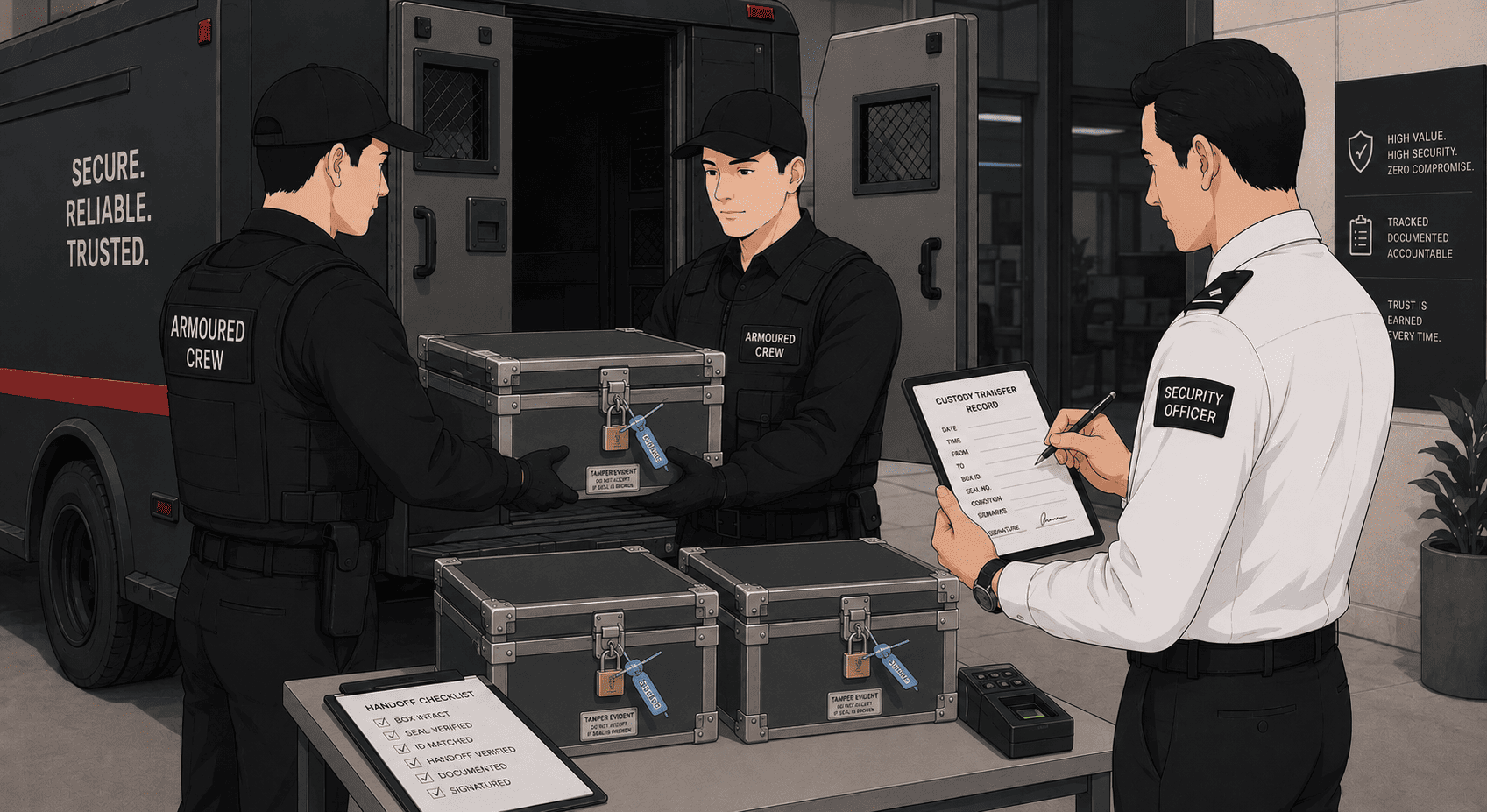
Two Industries. One Unsolved Problem.
Every time a cash-in-transit van pulls up to an ATM, it is solving a last-mile problem. One high-value item. One destination. One verified handoff. A tamper-evident container. A documented custody transfer. The person receiving it confirms receipt before the van leaves.
That is not a bulk logistics operation. That is last-mile delivery — with security standards built around what is actually being moved.
Jewellery delivery is the same problem. A ₹2 lakh ring leaving a store in Jubilee Hills and arriving at a customer's door in Banjara Hills is structurally identical to an ATM replenishment. High value. Compact. A single recipient. A handoff that either happens cleanly or creates a dispute with no resolution.
The difference is that cash logistics built a system around that handoff decades ago. Jewellery delivery still relies on a gig-economy rider and a prayer.
The Gap
Gig-economy last-mile vs CIT-grade last-mile
Store to customer's door — two very different operations.
Gig-economy delivery
Cash-logistics-grade
What Cash Logistics Gets Right
The cash-in-transit industry did not arrive at its current standard through regulation. It arrived there through failure — repeated, costly, reputational failures that forced the industry to engineer rigour into every step of the last-mile handoff.
The lessons are not secret. They are first principles that apply to any last-mile delivery of high-value goods — including a jewellery piece going from a store to a customer's home.
Banks do not trust people with cash. They trust systems. The same logic applies here.
Every handoff is a risk event — not a formality.
When a cash-in-transit (CIT) executive delivers to an ATM, the handoff is a documented transfer. Both parties verify. The sealed cassette is confirmed intact. The transfer is logged permanently. A gig-economy rider dropping a ₹2 lakh ring at a customer's door treats that same moment as just another item to tick off.
The container is evidence.
A tamper-evident seal on a cash cassette is a legal instrument. A broken seal is a reportable event. The same principle applied to a jewellery delivery means any access between store and customer's door is immediately visible. Most jewellery shipments travel in packaging where a compromised seal looks identical to an intact one.
Personnel verification is proportional to what they carry.
A CIT executive handling an ATM replenishment undergoes criminal history checks, financial background screening, and ongoing monitoring. A gig-economy rider delivering a ₹1 lakh bracelet to a customer's home goes through Aadhaar and PAN verification — designed for volume throughput, not high-value last-mile accountability.
Insurance is designed for the actual risk.
CIT insurance is written for specific last-mile failure modes. Jewellery delivery insurance — where it exists at all — is typically a declared-value mechanism with a claims process never designed for the speed a high-value loss at the customer's door requires.
Technology is accountability infrastructure — not a customer feature.
GPS tracking in CIT operations is an internal tool. Any deviation from the route to an ATM triggers an alert. Extended stops trigger escalations. The same technology applied to jewellery last-mile delivery makes every deviation between store and customer's door immediately visible.
This is precisely why general-purpose courier infrastructure struggles with high-value goods. See how these principles apply to jewellery delivery in Hyderabad →
Why Jewellery Last-Mile Delivery Has Not Made This Leap
Honest answer: for most of jewellery retail's history, last-mile delivery to customers barely existed. Customers came to the store. The last-mile was a showroom visit, not a logistics operation.
When home delivery did happen — a piece sent to a loyal customer, a repair returned — it was low volume and handled by a trusted individual, often a known employee. At that scale, trust could substitute for process. The risk was contained.
D2C changed that entirely. When a jewellery brand starts fulfilling hundreds of customer orders a month — pieces going directly to doorsteps across the city — the trusted individual model collapses. The volume demands gig-economy logistics. The value demands cash-logistics-grade last-mile security. The market has been trying to use the first to do the job of the second.
Very few companies have attempted to rebuild jewellery delivery from cash-logistics first principles. mintcrate is one of them.
What mintcrate Is Translating
mintcrate's operational model takes CIT last-mile principles and rebuilds them for jewellery delivery to customers. Not the armoured vehicles. The operational DNA — applied to the specific moment a piece leaves a store and arrives at a customer's door.
Every shipment moves in a tamper-proof, sealed crate. Every handoff is photo-documented — at the store before dispatch, and at the customer's door at delivery. Every delivery executive is police-verified. Every custody event between store and customer is logged in real-time. Insurance is embedded into the architecture, covering the full last-mile journey including the handoff itself.
The technology layer — GPS tracking, AI risk scoring, live custody dashboards — exists as accountability infrastructure. It creates the evidence layer that makes disputes resolvable, claims processable, and failures visible before they become losses at the customer's door.
Who Moves First — and Why It Matters
D2C jewellery brands are the natural first movers. They are not constrained by legacy showroom operations or decades of doing things a certain way. They can adopt this model and build a trust advantage over competitors before traditional jewellers catch up.
The next step in this trajectory is the dark jewellery store — a fulfilment-only model with no showroom, no walk-in retail, no high-street costs. A traditional jewellery showroom costs: prime real estate, elaborate interiors, custom display cases, floor staff, in-store security. Every rupee of that gets passed to the customer.
A dark store eliminates it. Jewellers stop investing in real estate and start investing in what the customer actually buys. Customers get better value. The brand gets better margins and faster turnaround. The D2C brands building secure delivery today are building exactly what that model needs.
The Future Is AI. The Problem Is Still Trust.
AI can recommend a piece of jewellery. It can compare prices, verify certification, and place the order. Within a few years, AI shopping agents will handle the entire purchase process on a customer's behalf — from discovery to checkout — without the customer speaking to anyone at the store.
None of that changes what happens next. The physical movement of a ₹2 lakh diamond from a store to a customer's door still requires a chain-of-custody, a tamper-evident container, a verified person carrying it, and a documented handoff at both ends. AI can automate the transaction. It cannot automate the trust.
Cash logistics understood this a long time ago. Banks did not stop investing in armoured vehicles and custody protocols when they digitised their payments infrastructure. The physical movement of value remained a separate, security-grade problem. The digital layer made transactions faster. The physical layer is what kept them honest.
Jewellery delivery is facing the same challenge. Digital commerce is accelerating. AI is removing friction from discovery and purchase. The last-mile — the physical handoff — becomes the only remaining trust variable. The brands that solve it now are building infrastructure that compounds in value as everything else around it automates.
The Bottom Line
Cash logistics solved the high-value delivery problem decades ago.
The jewellery industry is facing the same problem today, at scale, with infrastructure that was never designed for it.
The principles are well understood. The difficult part is adapting them to jewellery economics and making them accessible to brands that are not banks.
The question is not whether jewellery deserves cash-logistics standards. The question is why it has operated this long without them.
Sources
- Munich Re Cargo Theft Tactics Report 2025
- RBI Guidelines on Cash Management Services — Reserve Bank of India
- India Jewellery Market Forecast 2025–2033 — IMARC Group
- Tracxn D2C Jewellery India Report — CXOToday, October 2024
- India D2C Ecommerce Market Analysis — Mordor Intelligence, 2026
- HSBC Global Research — India Quick Commerce Dark Store Projections, 2025
Anurag Yadav
Co-Founder, mintcrate
Anurag is the co-founder of mintcrate. He has spent the last two years building secure last-mile infrastructure for high-value goods across Hyderabad — studying delivery failure modes, working with cash-logistics protocols, and designing the operational systems that mintcrate runs on. He writes about last-mile logistics, D2C operations, and the future of secure commerce in India. Connect on LinkedIn →
mintcrate Service
Secure Jewellery Delivery in Hyderabad
Cash-logistics rigour applied to jewellery delivery — verified personnel, custody logs, tamper-proof crates, embedded insurance.
See How It Works →Continue Reading
More from the mintcrate Blog
Ready to bring cash-logistics rigour to your deliveries?
See how the same principles banks use to move cash apply to jewellery delivery.