"What will it cost to send this securely?"
It is the first question every jeweller and every buyer asks. It is also the question almost nobody answers straight. Search for it and you get vague lines about how "insurance adds to the charge," with no number attached.
The reason is simple. Secure delivery has no flat rate, because the thing being priced is not the parcel. It is the risk. Once you understand the four or five things that set the price, you can estimate the cost yourself — and spot when a quote does not add up.
Why There Is No Flat Rate
A normal courier prices a parcel on weight and distance. A 200-gram packet from Hyderabad to Pune costs the same whether it holds a phone case or a diamond ring.
Secure jewellery delivery does not work that way, and it should not. The cost of moving a ₹5,000 silver chain and a ₹15 lakh bridal set across the same route is not the same, because the amount at stake is not the same. The packaging, the personnel, the insurance, and the documentation all scale with value. You are paying to protect what is inside the box, not to move the weight of the box.
That is why a real quote always starts with one question: what is the declared value? Anyone who gives you a flat per-parcel price for high-value jewellery without asking that is either underinsuring the shipment or has not thought about what happens when it goes missing.
Why We Wrote This
At mintcrate, we price secure deliveries for jewellery, gold, and diamonds in Hyderabad every day. The most common thing we hear from a new jeweller is that they could never get a clear answer on what secure delivery should cost — only flat courier rates that quietly leave the value uninsured.
We have also spoken to jewellers who discovered their standard courier's liability cap after a loss — almost never before. The gap between what they expected to recover and what the courier offered was, in most cases, the full value of the piece. The courier paid out a few hundred rupees on a consignment worth lakhs.
So we are putting the full cost anatomy in writing. No quote attached, no pitch — just how the number is built, so you can check any quote you are given against it.
The Five Cost Drivers
Every secure jewellery delivery price is built from the same five inputs. Change any one and the number moves.
The Anatomy of the Price
What you are actually paying for
1. Declared value — the lever that moves everything
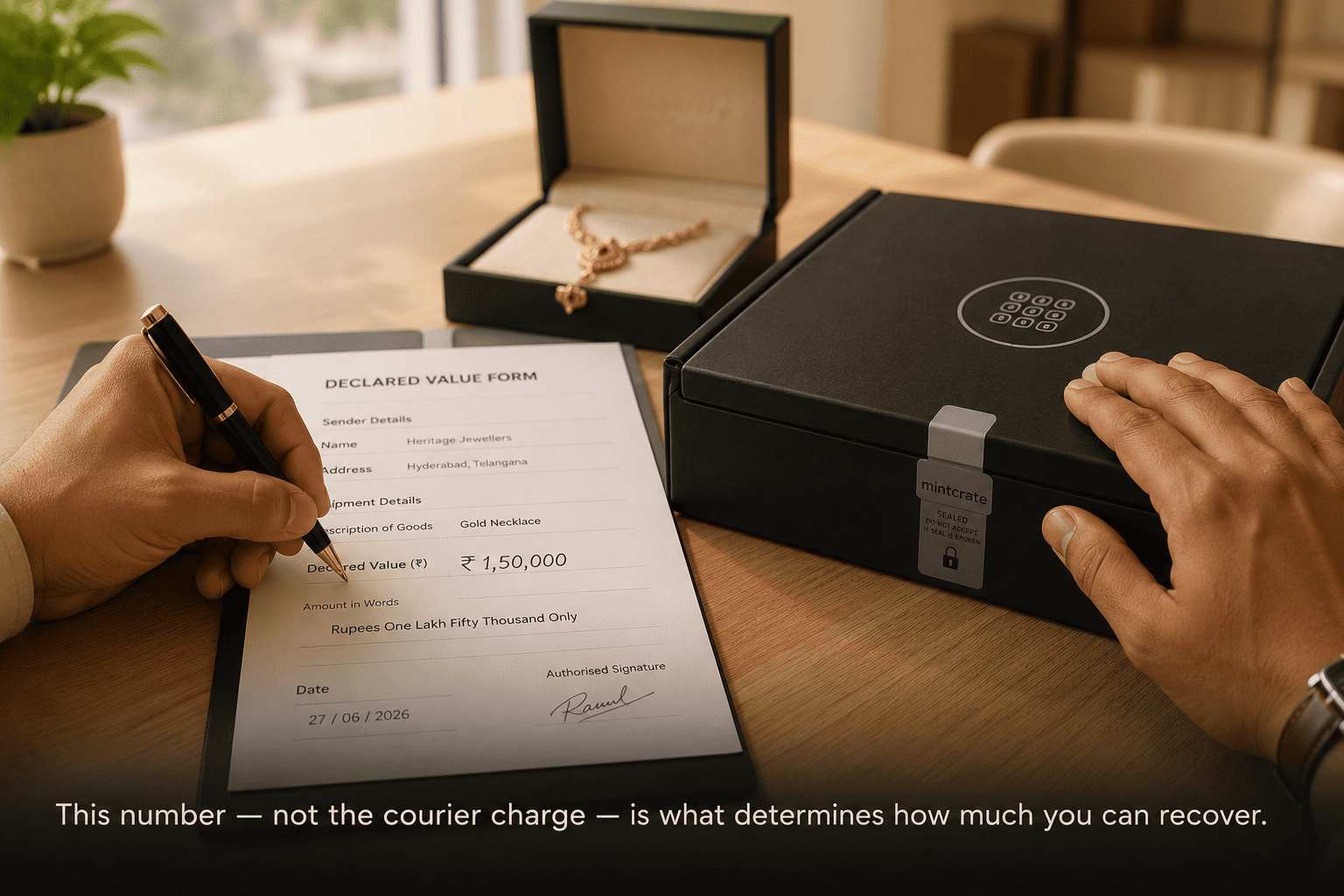
Declared value is the honest market value of what is being sent. It is the single biggest input, because two other drivers depend on it: the insurance premium is a percentage of it, and the custody tier is usually chosen around it. A ₹20,000 delivery and a ₹5 lakh delivery are different products, not the same product at a different price.
Underdeclaring to save on premium is the most expensive mistake a jeweller can make. If the declared value is ₹50,000 and the actual piece is worth ₹3 lakh, a claim pays out on ₹50,000. The ₹2.5 lakh gap is uninsured, and it is gone.
2. Route and distance
A delivery within Hyderabad is a single handoff on a known route. An inter-city consignment is longer in transit, passes through more hands, and carries more exposure at each leg. Distance matters, but for high-value goods the real cost driver is the number of custody transfers between collection and delivery, not the kilometres.
3. Custody tier
This is where most of the visible price difference sits. The same piece can travel three ways: a standard rider with basic tracking, a police-verified executive with tamper-proof packaging and live GPS, or a fully guarded movement for very high consignments. Each tier is a different cost because each is a different level of protection. Most jewellery sits comfortably in the middle tier — a verified executive with sealed packaging and a documented chain of custody.
4. Transit insurance
Insurance for high-value transit is priced as a percentage of declared value. The exact rate depends on value, route, and the security of the handling, but the structure is always the same: the more the item is worth, the higher the premium in absolute terms, even when the percentage is small. This is the line standard couriers either exclude or cap so low it is meaningless for jewellery.
5. Verification and documentation
OTP confirmation, a photo of the handoff, a tamper-proof seal logged at collection, and a full audit trail. This layer adds modest cost and removes most of your dispute risk. When a customer claims a set arrived incomplete, the difference between a refund you cannot contest and a closed case is whether anyone documented what went into the box. That documentation is part of what you pay for.
How Transit Insurance Is Priced — A Worked Example
The insurance line confuses people more than any other, so here is how it works in practice. The numbers below are illustrative — your actual rate depends on the insurer, the route, and the security tier — but the method is what matters.
Say you are sending a ring with a declared value of ₹1,50,000, and the transit premium for your route and security tier works out to 1% of declared value. The insurance portion of your cost is ₹1,500. If something happens in transit, you recover the full ₹1,50,000.
Now scale it up. A consignment declared at ₹15,00,000 at the same 1% rate carries a ₹15,000 insurance line. Larger in rupees, identical in logic. The percentage is small. The absolute figure grows because the amount being protected grew.
Compare that to the alternative. A standard courier's liability for a lost parcel is typically capped at a few thousand rupees, regardless of what was inside. Send that same ₹1.5 lakh ring by ordinary courier and lose it, and you recover the cap — not the value. The ₹1,500 premium was never the cost. The uninsured ₹1.5 lakh was.
This is the false economy at the centre of jewellery delivery. The cheapest option on the day of sending is almost always the most expensive option the day something goes wrong.
Angadia vs Standard Courier vs Specialist Secure Delivery
For high-value jewellery in India, there are really three ways to move it. They are priced very differently, and the cheapest sticker price hides the highest real risk.
The Angadia network is the traditional trust-based courier system the jewellery trade has used for generations. It is fast, informal, and often the cheapest upfront. The catch is that there is no insurance, no chain of custody, and no audit trail. The entire system runs on personal trust, which works until the day it does not — and when it fails, there is no document to recover anything with.
A standard courier with add-on insurance looks like the safe middle. In practice, the insurance is usually capped well below jewellery value, the packaging is not tamper-proof, and nobody photographs the handoff. You pay a parcel rate plus a premium and still carry most of the real risk yourself.
Specialist secure delivery prices the protection in from the start: full transit insurance on declared value, tamper-proof packaging, verified personnel, and a documented chain of custody. It is not the lowest sticker price. It is usually the lowest real cost, because the loss it is built to prevent is the one that actually bankrupts a small jeweller.
| What you compare | Angadia / informal | Standard courier + insurance | Specialist secure delivery |
|---|---|---|---|
| Upfront price | Lowest, informal | Low to moderate | Moderate, value-based |
| Insurance on full value | None | Usually capped low | Full declared value |
| Tamper-proof packaging | No | No | Yes, sealed at collection |
| Chain of custody | None | Basic tracking | Documented end to end |
| Proof if disputed | None | Minimal | Photo + OTP + audit trail |
| Real cost of a loss | Borne in full by you | Mostly borne by you | Recoverable via insurance |
The gap in the Indian market sits exactly between these. Angadia is cheap and opaque. Global armoured carriers are secure but priced for bullion houses, not a Hyderabad jeweller sending a bridal set across town. Specialist secure delivery exists to fill that middle: the protection of the high end, priced for everyday high-value jewellery.
One Cost Most People Forget: Documentation
For jewellers moving stock, there is a compliance layer that occasionally carries its own cost. Depending on the state and the value, movement of gold and precious goods can require an e-way bill, and the rules vary by state rather than following one national standard. For a buyer sending a personal item, this rarely applies, but for a business dispatching stock it can, and a delivery partner who handles that paperwork correctly saves you a different kind of expense — the cost of a consignment held up or questioned in transit.
The point is not the bill itself. It is that "cost" for a jeweller is not only the delivery fee. It is the fee plus the insurance plus the value of never having a shipment stuck because the documentation was wrong.
How to Estimate Your Own Cost Before You Call Anyone
You do not need a quote to get a working estimate. Run these four steps and you will know roughly where you stand — and what any quote should look like.
- Fix the declared value. Use the honest market value of the piece, not a rounded-down figure. This is the number everything else is built on.
- Pick the custody tier. Local, low-value consignments can sit at the standard tier. Anything from a few tens of thousands upward warrants a verified-executive, tamper-proof tier. Very high consignments need guarded movement.
- Estimate the insurance line. Take your declared value and apply a small percentage for the transit premium. That gives you the insurance portion in rupees.
- Add the handling and route fee. The base service fee covers the personnel, packaging, verification, and the leg itself. This is where distance and number of handoffs show up.
If a quote you are given is far below this, find out what was dropped — almost always it is the insurance, the custody tier, or the documentation. A low number that quietly removes the protection is not a cheaper delivery. It is an uninsured one.
Go Deeper
Cost is one part of the picture. For the full standard — packaging, insurance, chain of custody, and what to look for in a delivery partner — see the Complete Guide to Secure Jewellery Delivery in India.
FAQ
How much does it cost to send jewellery securely in India?
There is no flat rate. The price is built from declared value, route, custody tier, and a transit insurance premium that is a percentage of declared value. A local low-value delivery and a multi-lakh inter-city consignment are different products at different price points, so any honest quote starts by asking the declared value.
Is insured courier worth the extra cost for jewellery?
For anything above a few thousand rupees, yes. Standard courier liability is capped far below jewellery value. Paying a small transit premium to insure the full declared value is far cheaper than absorbing a total loss the courier will never reimburse.
What is cheaper — Angadia or a secure delivery service?
Angadia usually looks cheaper because the cost is informal and undocumented. But with no insurance and no audit trail, the real cost only appears when something goes missing and there is nothing to recover it with. Specialist secure delivery prices that protection in from the start.
Why do secure jewellery deliveries cost more than normal parcels?
A normal parcel is priced on weight and size. A secure jewellery delivery is priced on value at risk — full transit insurance, tamper-proof packaging, verified personnel, and a documented chain of custody. You are paying to protect the value inside the box, not to move the box.
The Bottom Line
Secure jewellery delivery has no flat rate because it is priced on the one thing that actually varies: how much is at stake. Declared value, route, custody tier, insurance, and documentation — get those five clear and the number stops being a mystery.
The cheapest option on the day of sending is rarely the cheapest in the end. A jeweller who insures the full value and documents the handoff pays a little more upfront and never has to absorb a loss the courier was never going to cover.
Delivery is part of the product.
Anurag Yadav
Co-Founder, mintcrate
Anurag is the co-founder of mintcrate, building Hyderabad's secure delivery service for jewellery, lab grown diamonds, and high-value goods. He writes about last-mile logistics, D2C operations, reverse logistics, and the future of secure commerce in India. Connect on LinkedIn →
Sources
- e-Way Bill Applicability for Gold and Precious Stones — ClearTax / IndiaFilings, 2025–2026
- Intra-State E-way Bill Rules for Gold & Precious Stones — TaxGuru, 2023–2024
- Shipping Luxury Watches and Jewellery: insurance priced on declared value — DHL Express guide, 2024
- India Jewellery Market Size and Forecast 2025–2033 — IMARC Group, 2025