The necklace was ready two weeks before the wedding.
The jeweller was in Chennai. The wedding was in Hyderabad. The family had bought the bridal set there on a trip six months earlier and asked the jeweller to make a few alterations. It was ready. It needed to travel.
They sent it by a courier service they had used before for documents. It arrived. The outer box was intact. The inner box had been opened and resealed. The necklace was there. The matching earrings were not.
That scenario is not unusual. It is a version of something we hear about every wedding season — a family moving jewellery between cities under deadline pressure, using whatever courier is cheapest or most familiar, and discovering the gap in that approach at exactly the wrong moment.
Occasion deliveries — weddings, Dhanteras, Akshaya Tritiya, anniversary gifts — are the highest-risk category in jewellery logistics. The value is concentrated. The deadline is fixed. The emotional stakes mean that even a delay, let alone a loss, is genuinely unrecoverable. And yet most families and most jewellers treat them like any other dispatch.
Why Occasion Deliveries Are Higher Risk
Three things make a wedding or festive delivery structurally riskier than a routine one.
The value is higher. Bridal sets, family heirloom pieces, and Dhanteras gold purchases are among the highest-value single consignments most families ever move. A routine delivery might be a ₹20,000 pair of earrings. A bridal delivery is often ₹3–10 lakh in a single box, sometimes more.
The deadline cannot move. A routine delivery can be resent if something goes wrong. A wedding cannot be rescheduled because the jewellery did not arrive. That deadline pressure changes every decision: families skip proper verification to save time, jewellers use the fastest available courier rather than the most secure one, and nobody builds in the buffer that would allow a problem to be fixed.
Festive season is when delivery fraud spikes. Dhanteras and Akshaya Tritiya generate some of the highest-volume delivery days of the year. More volume means more handoffs, more riders operating under time pressure, and less accountability at each step. E-commerce volume spikes during peak festive windows frequently correlate with a rise in parcel-swap incidents and delivery handoff friction across mainstream logistics networks. The incidents appear to increase because the conditions for fraud become more favourable.
The Cross-City Bridal Problem
"How do I send wedding jewellery to another city safely?" is one of the most common questions families ask in the weeks before a wedding — and one of the least clearly answered. India's jewellery market is not uniform. Families in smaller cities routinely source bridal jewellery from hub regions like Hyderabad, Chennai, Mumbai, or Jaipur — cities with deeper craft traditions or design styles unavailable locally. A family in Warangal buying their bridal set from a Hyderabad store is not unusual. It happens every wedding season.
The typical solution is informal: a family member travelling from Hyderabad carries the piece back. But this assumes there is a family member available to make the trip. Smaller families today often mean one or two people carrying the entire weight of planning a wedding — the venue, the catering, the guest list, the ceremonies. Adding a trip to Hyderabad specifically to collect jewellery, coordinate with the jeweller, and travel back safely is not always possible. And when it is not, the alternatives are either a courier or asking someone who is already overwhelmed to add one more thing to their list. This shift — fewer family members, more decisions falling on one person — is part of the same change that has made home delivery the default expectation for jewellery buyers across India.
Even when a family member makes the trip, they are often travelling with ₹5 lakh of jewellery in a bag with little formal protection if something goes wrong. The security of that arrangement depends largely on nothing going wrong.
When the jeweller ships instead, a different gap opens. Families who choose to send bridal jewellery by courier are often unaware of what the terms actually cover. What travels between cities is a box worth several lakhs, handed to a courier who treats it identically to a parcel of clothing. The declared value on the form is whatever the system allows — often capped at ₹50,000. The actual value is ₹5 lakh. If something happens in transit, the courier pays out the cap, leaving the family exposed to the remaining loss.
We have covered how standard courier terms handle jewellery — and where they fail in detail. For a cross-city bridal delivery, that gap is not theoretical. It is the entire risk.
What Festive Season Does to Delivery Risk
Dhanteras and Akshaya Tritiya are among the highest-volume gold purchase days of the year in India. Online gold purchases typically increase significantly in the weeks before both occasions — and that volume travels through the same delivery networks that handle groceries and apparel.
The risk is not just theft. Rushed handoffs during peak volume mean documentation is skipped, packages are mis-sorted, and the chain of custody that would normally catch a problem is compressed or absent. A delivery executive handling dozens of parcels on a Dhanteras evening is not operating at the same standard as one handling 20 on a Tuesday in March.
Festive periods also create conditions in which fake-agent incidents become more common. A fraudster who knows a household is expecting a high-value gold delivery has a narrow but predictable window. Families waiting for Dhanteras gold are, by definition, expecting a package — which makes them easier to deceive at the door.
The OTP fraud and parcel-swap patterns we documented across platforms are concentrated in exactly these high-value, high-volume windows. The timing is not coincidence.
The Pre-Dispatch Checklist
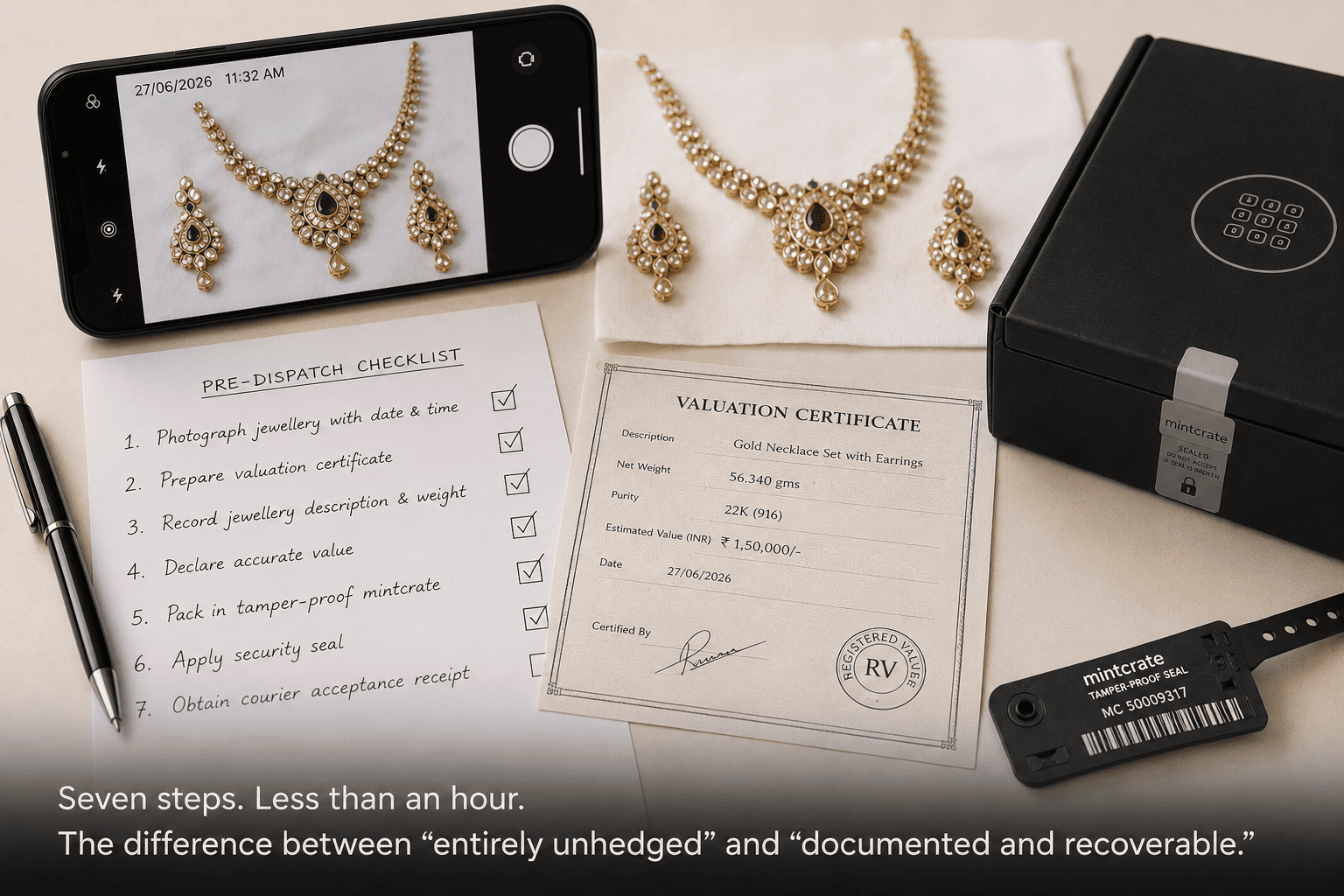
Seven things to confirm before a high-value piece leaves for a wedding or festive occasion. This applies whether you are the buyer arranging the dispatch, or the jeweller handling it on behalf of a customer. If you are also choosing which jeweller to trust with the dispatch, the five questions to ask your jeweller before home delivery are worth reading first.
Pre-Dispatch Checklist — Occasion Delivery
Timing Guide
When to book, relative to the wedding or occasion
What a Secure Occasion Delivery Looks Like
The piece is photographed at the jeweller's premises before packaging. It goes into a tamper-proof crate — not a box, not a pouch — with a logged seal ID. A verified logistics executive collects it at a scheduled time, signs the custody transfer, and the route is GPS-tracked from collection. The recipient gets a notification with the seal ID before the delivery arrives, so they know exactly what to check at the door. Delivery is confirmed with OTP only after the recipient has opened the outer packaging and verified the seal is intact. This is the same rigour cash logistics applied to ATM deliveries decades ago — applied now to the window where jewellery stakes are highest.
Every step produces a record. If anything is disputed — a missing piece, a damaged setting, a delivery that "arrived" but was left with a neighbour — there is documentation at each handoff to establish exactly where the problem occurred and who was accountable. Without it, the brand promise breaks at the door and there is nothing to recover it with.
That is what mintcrate's occasion delivery covers. The same chain of custody used for standard jewellery deliveries in Hyderabad, applied to the window where the stakes are highest.
A Note for Jewellers Handling Festive Dispatch
Wedding season and Dhanteras are your highest-volume dispatch windows and your highest-liability ones. A store sending ten bridal sets in the week before a wedding season peak is carrying tens of lakhs of exposure across those ten deliveries — potentially uninsured or underinsured if a standard courier is used.
We have spoken to jewellers who spend months helping a family choose the right bridal set, then spend five minutes deciding how to ship it. The selection process is careful. The dispatch decision usually isn't.
We have seen jewellers absorb losses silently during festive season because the alternative — disputing a standard courier's liability cap — is a months-long process that rarely ends in recovery. The better calculation is to price the secure delivery into the order upfront. For a piece worth ₹5 lakh, the cost of specialist secure delivery is a fraction of a percent of the value at risk. The customer sees it as a reason to trust you with the order. The store removes a liability that is otherwise entirely unhedged.
The full cost breakdown of secure jewellery delivery is worth reading if you are pricing this into your dispatch model for the first time.
FAQ
What is the safest way to send wedding jewellery to another city?
Use a specialist secure delivery service with full transit insurance on the declared value, tamper-proof packaging sealed at collection, a verified executive for handoff, and OTP-confirmed delivery. Standard couriers cap liability far below the value of bridal jewellery, leaving most of the risk with you.
Is it safe to get gold delivered during Dhanteras?
It can be, but e-commerce volume spikes during festive windows frequently correlate with a rise in parcel-swap incidents and delivery handoff friction. More handoffs, more riders under time pressure, and less accountability at each step. Book a specialist secure delivery service well in advance, confirm the insurance covers the full declared value, and never share the OTP before inspecting the package.
How early should I arrange festive jewellery delivery?
For inter-city shipments, book at least 5–7 days before the occasion — specialist delivery slots fill quickly during festive periods and a rushed arrangement is where most incidents happen. For local delivery within Hyderabad, mintcrate offers same-day secure delivery within 2–4 hours, so last-minute occasions within the city are covered.
Can I send gold jewellery by normal courier for a wedding?
Technically yes, but standard couriers cap their liability at a declared value usually far below the actual value of bridal jewellery. If something goes wrong in transit, you recover the declared cap — not the piece. For wedding jewellery worth lakhs, that gap is not a risk worth taking.
Before It Leaves the Store
Occasion deliveries are where the stakes are highest and the preparation is usually the lowest. The piece took months to commission, the wedding took a year to plan, and the delivery gets arranged in a hurry three days before it needs to arrive.
The checklist above takes less than an hour to work through. Valuation certificate, dispatch photos, confirmed insurance, tamper-proof seal, verified personnel, enough lead time, and OTP discipline at the door. Seven steps that take the risk from "entirely unhedged" to "documented and recoverable."
Delivery is part of the product.
Anurag Yadav
Co-Founder, mintcrate
Anurag is the co-founder of mintcrate, building Hyderabad's secure delivery service for jewellery, lab grown diamonds, and high-value goods. He writes about last-mile logistics, D2C operations, reverse logistics, and the future of secure commerce in India. Connect on LinkedIn →
Sources
- India Gold Demand Trends — World Gold Council, Q4 2025
- India Jewellery Market Forecast — IMARC Group, 2025